Food Industry & Processing Pest Control Brisbane
Documented IPM programs, monthly auditor-ready reports, and integrated rodent monitoring for food manufacturers, processors, packagers, and cold storage facilities across Brisbane and Logan industrial zones. Built for BRC, SQF, HACCP, and AQIS audits.
Food Safety Standards We Support
Food industry pest management is not just about eliminating pests. It is about maintaining a documented, auditable program that demonstrates proactive control and continuous improvement. Our programs are built from the ground up to satisfy third-party auditor requirements across all four major standards used by Queensland food manufacturers.
Pest management as a prerequisite program. Treatment records, corrective action logs, and product registers maintained in HACCP file format. Compatible with all HACCP-based food safety programs.
BRC Issue 9 Section 4.13 pest control documentation. Signed service reports, trend analysis, site maps with numbered station locations, and auditor file updated monthly.
SQF Code 11.4 pest management system. Written IPM program, identified pest risks, treatment schedules, corrective actions, and annual program review included in the SQF documentation package.
Documentation for Australian Government Department of Agriculture AQIS-registered export-certified premises. Signed service reports with APVMA numbers and annual IPM program summaries.
Integrated Pest Management for Food Facilities
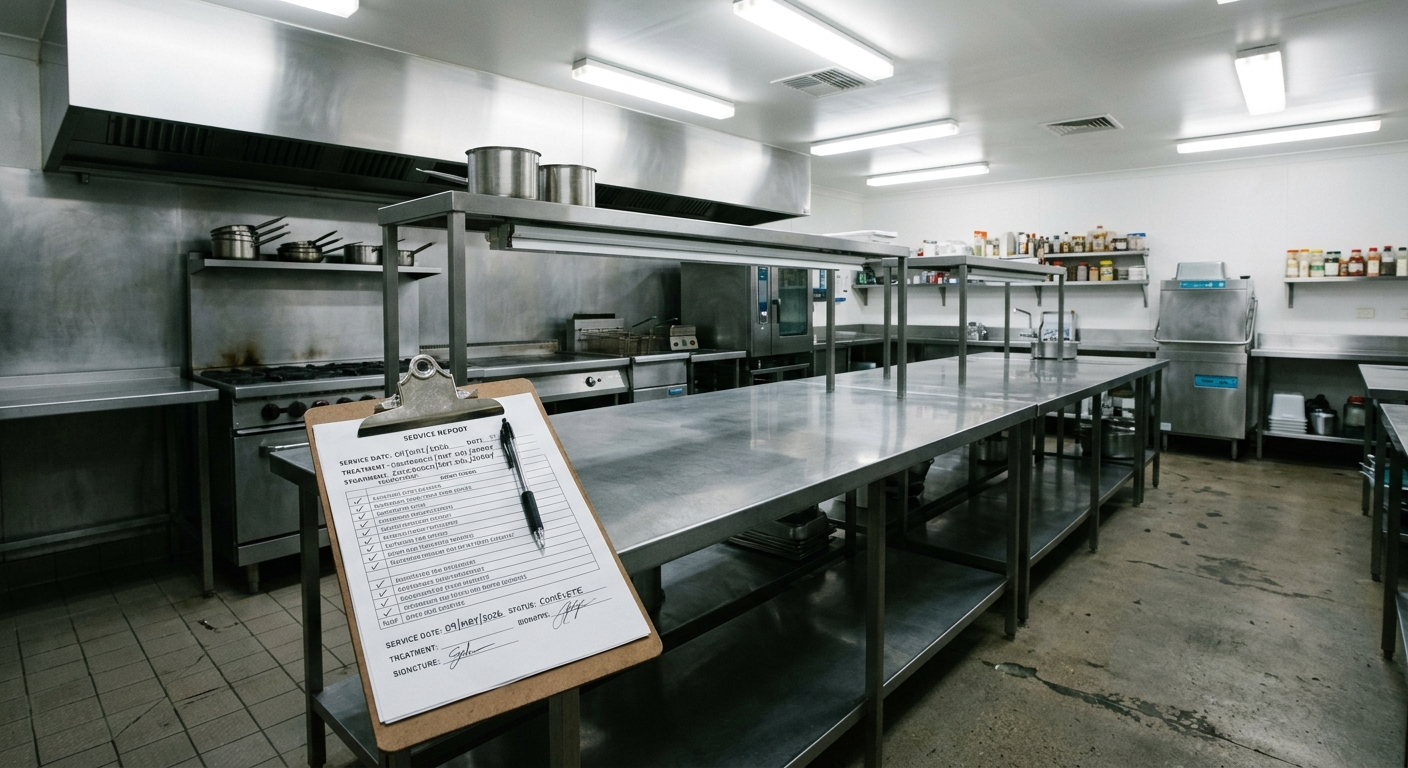
An IPM program for a food facility is not a spray schedule. It is a documented system that combines prevention, monitoring, and targeted treatment with a clear record of every action taken and every pest trend identified. See our restaurant pest control page for smaller food premises.
Written IPM program document
A facility-specific written IPM program covering pest risk assessment, treatment methods, product list with APVMA numbers, station map, treatment schedule, and corrective action protocols. Reviewed and updated annually or when the facility changes.
Zoned station mapping
Every bait station, UV light trap, and pheromone trap is numbered and marked on a site map. Station locations are reviewed when facility layout changes and the map is reissued to the audit file.
Trend analysis reporting
Activity levels recorded per station per visit. Month-on-month trend analysis identifies rising pressure zones before they become a problem. Trend data is included in the monthly auditor report and retained for 24 months.
Corrective action protocols
When activity exceeds defined threshold levels, a corrective action is triggered automatically. The action, cause, and outcome are documented in the corrective action log for BRC and SQF audit file requirements.
Integrated Rodent Monitoring Stations
Rodent activity in a food processing or storage facility is the highest-risk pest event possible. A single rodent in a production area can trigger a product recall, a regulator notification, or loss of certification. The monitoring network is designed to detect activity at the perimeter before it enters the production zone.
How the Station Network Works
Stations are placed in a structured network from the external perimeter inward through the loading dock, receiving, storage, and production zones.
Exclusion-Focused Treatments
Treatment in a food processing facility must prevent pests from entering as the primary objective, not just respond to pests already inside. Every site inspection includes an exclusion audit identifying structural gaps, drainage issues, and facility design factors that allow pest entry.
Structural gap audit
Documented assessment of all gaps, penetrations, and openings in the building envelope that allow pest entry. Written recommendations provided to facilities management with priority rankings. Follow-up inspection confirms closure before the next audit visit.
Loading dock proofing
Roller door brush seals, dock leveller gap management, and drain cover condition assessed on every visit. The loading dock is the primary rodent and cockroach entry point in any food facility and is treated accordingly.
Floor drain management
Floor drain covers inspected for condition and fit. Drain enzyme treatment to eliminate build-up that feeds drain fly populations. Drain fly activity in food processing is a common BRC non-conformance finding and is addressed on every visit.
UV light trap program
UV light traps positioned in receival, production approach corridors, and packing areas where flying insects are a contamination risk. Catch trays inspected and pest species recorded monthly as part of the trend report.
Stored product pest program
Pheromone-based monitoring traps in dry ingredient storage and packaging materials areas. Grain beetles, flour weevils, and Indian meal moths are identified early and contained to the affected stock before production lines are reached.
Pest-free zone documentation
High-care and high-risk production zones documented separately in the IPM program with their own treatment methods, monitoring frequency, and threshold levels. Meets BRC and SQF requirements for segregated zone pest management.
Monthly Auditor-Ready Reports
Every document in the audit file is produced as a matter of course, not assembled on request when an audit is approaching. The file is always current and ready for an unannounced third-party auditor visit.
| Document | Frequency | Standards | Contents |
|---|---|---|---|
| Service report | Every visit | HACCPBRCSQF | Technician, products, APVMA numbers, areas treated, findings |
| Station activity record | Every visit | BRCSQF | Per-station activity level (high/medium/low/nil) with pest species |
| Trend analysis report | Monthly | BRCSQF | Month-on-month activity by zone with commentary |
| Corrective action log | On trigger | BRCSQFHACCP | Trigger, action taken, root cause, close-out date |
| Product register and SDS | On change | HACCPBRCSQFAQIS | All products with APVMA numbers and current SDS sheets |
| Site map | On change | BRCSQF | Numbered station locations, trap types, and zone classifications |
| Annual IPM program review | Annual | BRCSQFAQIS | Program effectiveness, risk assessment update, schedule for coming year |
Food Industry Pest Control Pricing
All programs include the full documentation package. Pricing depends on facility size, production type, number of monitoring stations, and documentation requirements. A free site inspection is required before any food industry program is quoted.
Request a free site inspection or call 0406 178 471 to discuss your facility requirements.
Food Industry Pest Control FAQ
Get a Food Industry Program Quote.
HACCP · BRC · SQF · AQIS · Monthly Auditor Reports · Free Site Inspection